

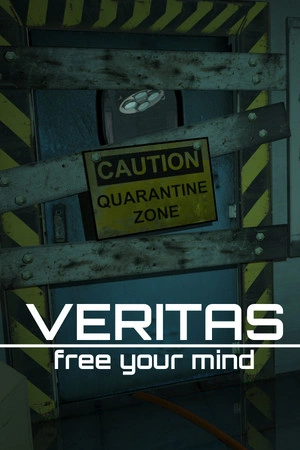
I have no recollection of buying Veritas whatsoever, and it wasn’t until I looked back over my email confirmations that I had any real understanding as to what enticed me to pick it up. It turns out I bought it on my birthday last year (which is kinda weird, since I unknowingly chose to play it on my birthday this year) – as it turns out, my girlfriend had taken me to a cool escape room that year, and I think I jumped on Veritas wanting something digitally similar.
And from the opening scenes, that’s exactly what I got. You awaken in a cramped cell, dotted with a few rather heavy-handed clues that will help you escape, as well as notes from a mysterious stranger, hinting at some sinister shared fate. Beyond the cell, you have to overcome a series of puzzles to unlock the cell block, and from there, the space seems to open up into some kind of research facility of dubious intention. It quickly becomes clear that you’re a man named John who has signed up for some kind of thought experiment with a company called Veritas Industries, but exactly what they’re up to isn’t entirely clear.
Thematically, Veritas is a bit all over the place. The introduction has a sinister psychological thriller vibe to it, with heavy use of blood and creepy motifs, but it doesn’t take long before it gives way to a more 1960s propaganda-laden think tank. Poking around the facility, taking in the various corporate posters and reading scattered notes written by other background characters, reveals that The Matrix and Inception are pretty clear inspirations, but it’s difficult to engage with anything too deeply, as much of the story is delivered via in-game computer terminals, which are a complete nightmare to use.
Set up as old school DOS-style menus, you’re asked to key in your selection using the Switch’s system keyboard before waiting for the text results to achingly unravel on screen. Once you’ve read the snippets of lore at the end of your selection, you have to select the option to go back, wait for the menu to load again, before keying in your next selection and waiting for that to load too. It took me a whole 10 minutes of faffing with these menus before deciding it wasn’t worth it and abandoning the backstory altogether. There’s nothing player friendly about the experience, and it actively turned me off even trying to understand what was going on. What’s worse, not accessing the story only further emphasises the shortcomings in the setting and theme.
And by that I mean that the puzzles and solutions are incredibly random. At first glance, it looks like the folks at Veritas Industries had the same planning director as Umbrella Inc. (of Resident Evil fame), because getting around and unlocking doors requires some of the most convoluted logic I’ve ever seen. From locks activated by playing a set of drums, toy cars used in security scanners, to the use of a fruit (slot) machine – Veritas throws all manner of references at you when it comes to solving puzzles. It’s all a little silly, though I will say that the few bits of plotline I did uncover do help to make it clear why everything is so nonsensical, but it still feels like a bit of a cheap copout.

For all the randomness, I did enjoy most of the puzzles in Veritas, which range from the insultingly easy to the downright devilish. With the difficulty curve seemingly modelled after a rollercoaster, it’s handy to have an in-game hint system that you can access at any time, offering varying degrees of help until it simply gives you the solution in its entirety. While it can become easy to use these types of systems as a crutch, I found myself only having to use it once or twice, sometimes acting more as a helpful reminder of something I’d forgotten about, saving me time wandering around reminding myself of everything.
Originally designed for mouse and keyboard, the Switch port uses an on-screen pointer controlled by the Joy-Con in docked mode, with touch controls also available when played in handheld mode. The left and right control sticks have different sensitivities that make it a little easier to accurately get around the screen, but it’s still clunky enough that I decided to play almost the entire game with the touch controls. I say “almost the entire game”, as there are several screens that just don’t respond to touch controls like they should. As a flaw, this one is pretty unforgivable, as it left me unable to access a number of areas or puzzles simply because the controls didn’t respond, leaving me unaware that they even existed. The interfaces and menus are pretty outdated, even when originally released in 2020, but opening up your inventory or the options screen is certainly simple enough to use.

Unfortunately, doing much of anything else in Veritas is like pulling teeth. Despite the game being made up of a series of prerendered slides, with the odd bit of animation for some spinning cogs or a flickering TV, the game moves at a snail’s pace. Interacting with absolutely anything is painfully slow – sometimes taking a full three seconds between tapping the screen and seeing the results, making every single interaction a protracted nightmare. While it’s clunky at the start, the lag seems to get worse and worse as the game goes on, almost as if every asset you’ve encountered is bumbling around the Switch’s memory at the same time. I know that the Switch was underpowered at launch and is now no spring chicken, but the performance of Veritas is enough to make you believe that actual blood sacrifice was used to make something like Tears of the Kingdom run at all.
So, a game that should take around 4-hours to complete took me more like 6.5, due to the incredibly sluggish performance. And when it was all said and done, I didn’t even get to see the credits roll, as the game froze on the final screen, leaving me utterly confused (though watching the post-credits scene on YouTube did little to illuminate me to be honest). Seemingly designed as some great ‘Aha’ moment, the parting image of Veritas is one that falls entirely flat, as the ‘twist’ was revealed within the first hour of the game to anyone paying even a modicum of attention. I guess the mystery that remains unsolved is how a bunch of pre-rendered backgrounds and simple menus can use so much processing power.


In summary, Veritas is a hodgepodge collection of puzzles, arranged next to one another with a chiffon-thin story thrown over the top to give the illusion of an adventure game. But even as just a random gathering of brainteasers, it would still manage to be passable if it didn’t run so horribly. I have never played a game so poorly optimised to the Switch; with results on-screen routinely taking 3-4 seconds to process after you push a button, it genuinely feels like something running on a 5 ¼ inch floppy disk. Veritas is a point-and-click misadventure from start to finish.


Thanks for taking the time to read our review, If you’d like to support us further, please consider buying us a coffee!
