

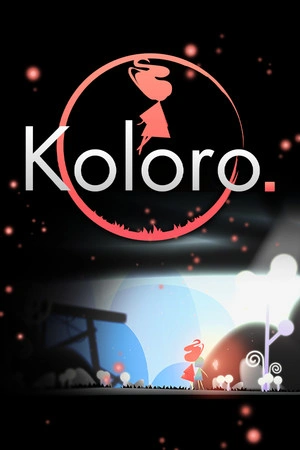
With just a glance at my backlog or any number of my reviews, it will quickly become clear that I’m ‘a platform guy’. Raised in Donkey Kong Country, maturing on Crash Bandicoot and forged in the fires of Celeste, I’ve played just about every type of platformer under the sun. I’m also a believer that complexity does not always equate to enjoyment, especially when it comes to video games, and it was at the intersection of these two ideals that I decided to pick up the simple handdrawn platformer, Koloro, back in 2020.
Koloro is a puzzle platformer that requires you to jump your little blocky character over traps and off walls to collect all the gems scattered across a series of single-screen mazes; once you’ve picked up all the gems, an exit will open, and you need to make your way there without dying to move onto the next level. You’ll have to push buttons to open new routes, while avoiding shadowy beasts, laser gates, and a whole lot of spikes on the way to your goal.
The key feature of Koloro is that it’s an autorunner, meaning your character will move forwards on their own and will only change direction when you perform a wall jump. This can make for some interesting traversal, as you always have to consider how you’re going to turn around in order to get around. It’s a game of patience and planning as much as it is about quick thinking and skill (much to my frustration at times).
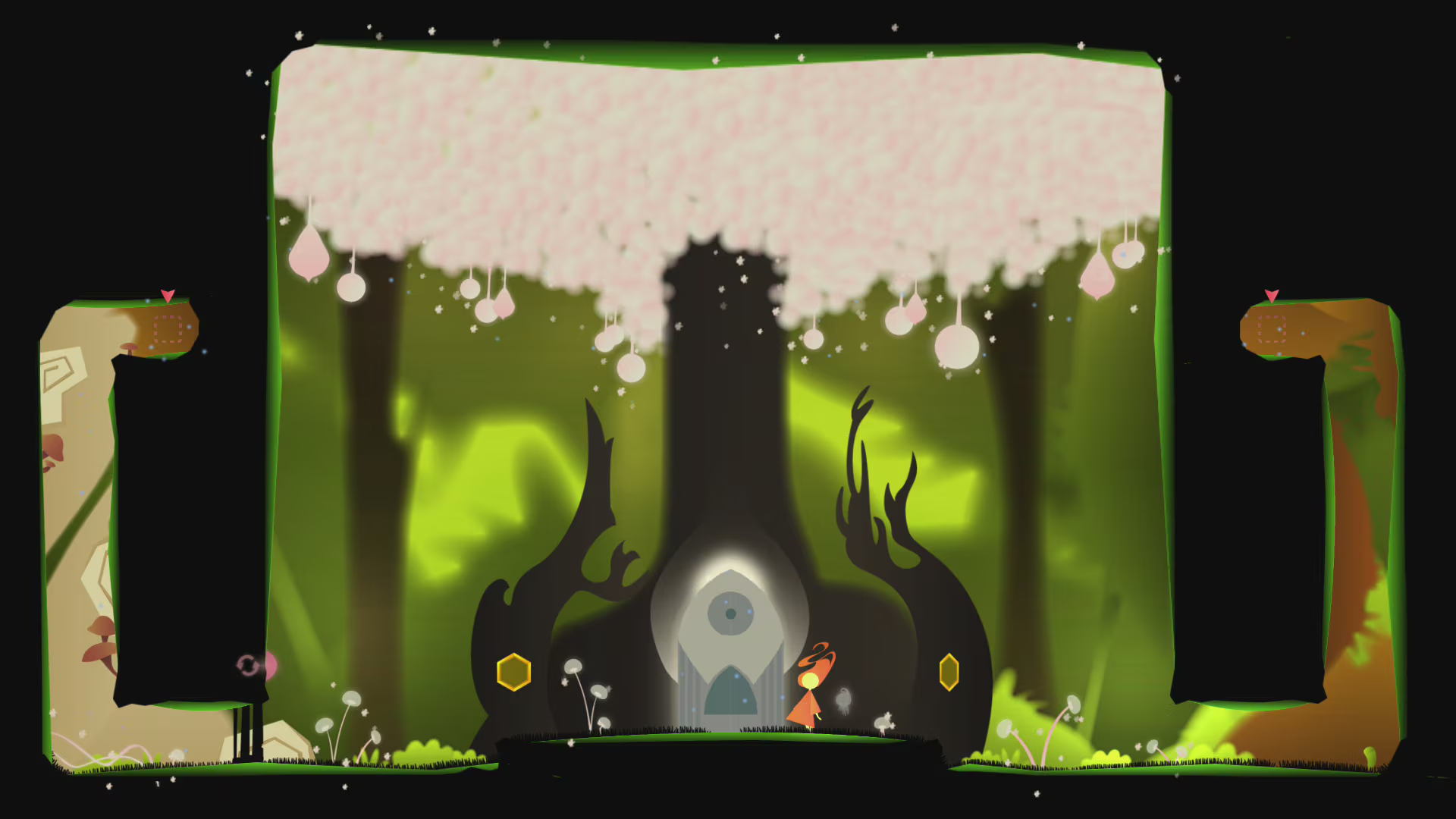
As you progress, the different worlds begin to change the rules a little bit, giving you altered abilities and adding additional layers to the challenge. For example, some levels have sticky walls, or disappearing and reappearing ethereal platforms. In the later levels you have to run through light sources so that you pick up their glow in order to navigate through the pitch black, or push a series of buttons to manipulate gravity to avoid floor-to-ceiling obstacles.
There are some nicely designed levels in Koloro; really making you think about how to get from A to B, while collecting all the necessary gems and avoiding all the pitfalls on the way to the exit. It’s a simple game in its design, so the puzzles on offer are more procedural than they are brainteasers. It was mostly ‘what order do navigate this maze in?’ type stuff, but that doesn’t mean there aren’t some genuinely tricky moments.
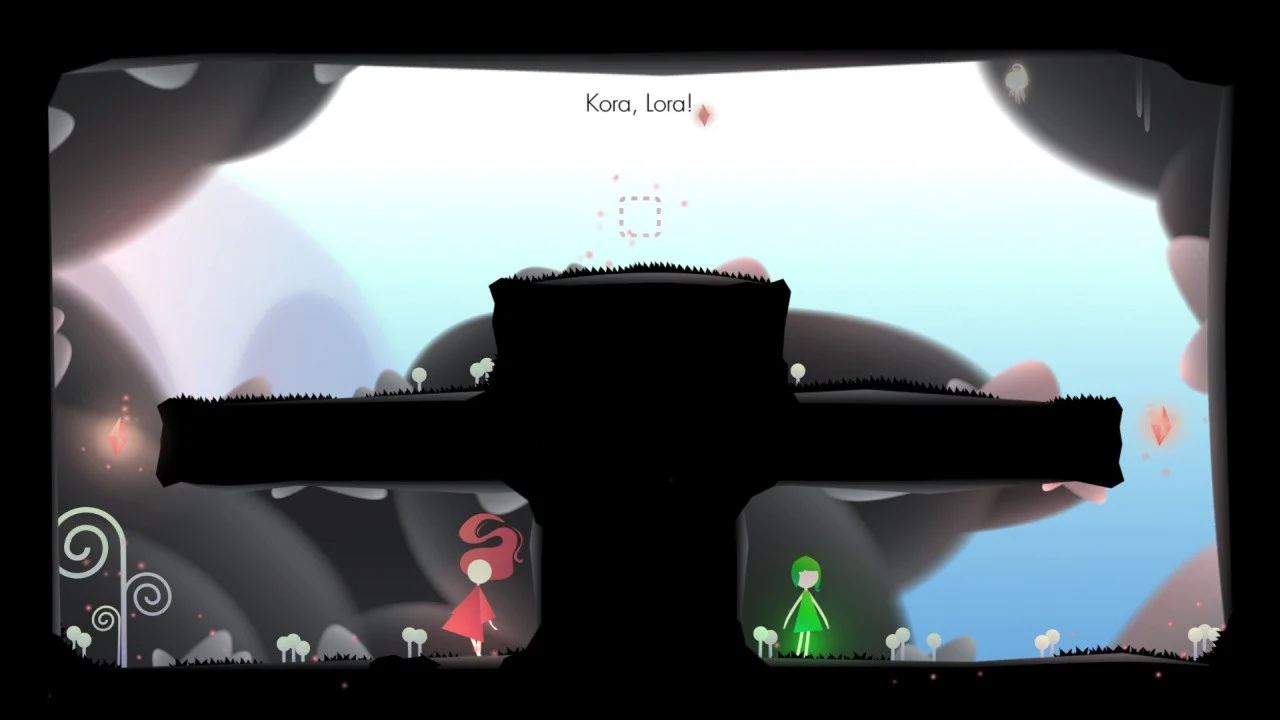
There’s a co-op mode too, if you fancy playing with a friend. Much of the gameplay remains the same – with the addition of platforms that are passable by players of the corresponding colour. While this does add another layer of puzzle solving, the 50 additional co-op levels are mostly more of the same, making Koloro a game you’ll play either in single-player or in co-op, but unlikely in both.
The game is mostly set to a chill, almost lo-fi soundtrack, which works wonders in keeping you call through some of the more frustrating moments. Your character’s jumps are punctuated by a cute little xylophone ‘plinky plonk’, and even the highpitched death sound gives the character a beautifully ethereal feel, in keeping with the loose storyline that unfolds throughout the game. The music gets a little more gravelly and stressful in the tense moments (like the boss levels), nicely shifting the ambience to match the situation.
While it is well-baked into the level design, I personally found the autorun nature of the Koloro a pain in the arse. I certainly don’t have the skills of one, but I do have the soul of a speedrunner, and having to wait until I reached a wall so that I could jump off it to turn around really began to bug me in some of the longer and more complicated levels. I just wanted to go back the way I came and not have to navigate a circuit of nine or ten routine jumps just to get back to my starting spot. Yes, I understand that it’s fundamentally part of the puzzle design, but it slows down even the most simple level into something three or four times as long as it needed to be.
Aside from the main character being a literal red block, the game has a nice aesthetic, with vibrant hand drawn backgrounds standing in stark contrast to the sturdy black platforms that make up the game’s mazes. Each world is differentiated by a unique background palette and some individual environmental elements (like forest flora or clockwork parts), but in the grand scheme of things, the visuals in Koloro don’t change a lot from start to finish.
Sadly, when all is said and done, the lack of variation is probably the most pervasive characteristic of Koloro. As a whole, it does a lot of things pretty well, but it’s so repetitive that it grows tedious after a while.


Koloro is a simple little puzzle platformer that can help you while away a few hours – especially if you’re in one of those moods where absolutely nothing looks appealing. But despite some cleverly designed levels, pleasant hand drawn backgrounds and chill lo-fi inspired soundtrack, I found that things got stale long before I reached the end. Whether it was the sheer volume of levels to get through, the slow pace of the autorun mechanics or just the general lack of variation, Koloro is best enjoyed a few levels at a time before moving onto something with a little more substance.


Thanks for taking the time to read our review, If you’d like to support us further, please consider buying us a coffee!
