

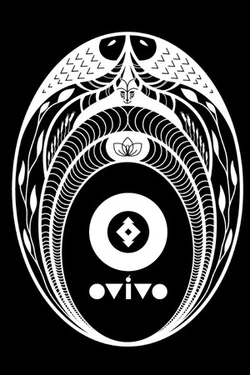
Despite my absolute lack of artistic ability (or perhaps because of it), I love art. I’ve often told my friends that I would trade my ability to write for an ability to draw in a heartbeat. Looking at the Nintendo eShop in late-2020, I remember quite vividly watching the trailer for OVIVO and immediately wanting to buy it – not especially for the gameplay, but for the incredible way that it looked. Almost five years later, I finally felt in a suitably artsy-fartsy mood, and decided to fire it up and see if I know art, and if I even know what I like!
OVIVO is a very short title and hangs its hat on a couple of different things to pull players through it from start to finish. In order of importance, they are: how it looks, how it sounds, then how it plays. I’m not suggesting that OVIVO is a product of style over substance, but made as an intentionally artistic project, in this case I’d argue that the style is the substance.
The gameplay is made up of some interesting one-button platforming, where you traverse the world by manipulating gravity. The environments in OVIVO are made up of bold monochrome scenes and the direction of gravity is defined by whether you’re currently residing in the white or the black world. By holding your jump button after you hit the ground, your character (read: blob) is drawn through the midline and onto the other side, where gravity is immediately flipped – you’re suddenly being pulled back towards the midline, only now from the other side. By using some clever physics you can build up momentum and jump higher/plunge deeper (delete as applicable) to navigate the stark and fantastical worlds.

The constant flipping gives traversal an odd undulating feel. It feels a little strange to start with, but I was surprised at just how instinctive the mechanics became after only a few minutes. In fact, I found that I was better at getting around when I was just going with the flow and not thinking about what I was doing at all. I seemed to get more bogged down with the physics in areas where the jumps were quite precise and I died a few times – somehow, respawning and going again from a cold start made me much more conscious of my button pressing, which sometimes got me in a bit of a jumble.
The platforming challenges are mostly made up by your mastery of the gravity mechanics, with the only real external threats being spike pits/ceilings, falling/patrolling type enemies and the inevitable plunge off the edge of the world. For those who especially enjoy exploring the surreal landscapes (or might be looking to expand their PSN Trophy collection), there’s the optional challenge of seeking out all the mysterious symbols hidden throughout the worlds, which actually ramps up the difficulty a fair amount. Not only are some of the symbols tricky to find, but they can also be equally tricky to collect.
The game is set to a stoic, mysterious score that fits the otherworldly visuals like a glove. Subdued hi-hats and snares lay the foundation for contemplative synth melodies that ring out as you traverse the eye-popping environments. The often slow and methodical style syncs up perfectly with the steady pace of the gameplay and the perplexing imagery on display.

For the most part, you perceive the game from a pretty standard perspective, and this gives you an intentionally limited view of the world that can seem to be a rather routine repetition of black and white in the early goings. But as you jump and dive your way through more of the levels you’re met with more lively surroundings that really add to the intrigue. Great fronds of flora voraciously sprout around you and multitudes of eyes open in the blackness to leer at you as you pass.
Everything is brought into stark perspective when you reach the end of the level though, as you’re suddenly offered a panorama of the huge fantastical world you’ve just overcome, filled with previously unseen wonders. Suddenly you realise you’ve been navigating the insides of a great fish or exploring the roots of a gargantuan tree. I found being able to see the sheer scale of the levels and the tremendous complexity of the images incredibly rewarding – much more so than I would ever have expected. While I don’t pretend to know from where Russian developers, IzHard, drew their inspiration for the artwork, to me the themes are deeply tied to nature and the natural order. There’s something almost tribal about the artstyle, and the great curving lines remind me very much of Aboriginal art, only not nearly as colourful.


OVIVO is an interesting platform experience that succeeds thanks to its mechanical simplicity and its artistic nature working completely in tandem. Simple one button controls allow you to instinctively wobble your way through beautiful monochrome environments, as a thoughtful synth music score pulses on in the background. There’s an intriguing mysticism dripping from the otherworldly images that make up the levels, if only you’re inclined to look, making OVIVO a game best enjoyed by players who value a contemplative artistic expression over tough, technical gameplay.


Thanks for taking the time to read our review, If you’d like to support us further, please consider buying us a coffee!


